 |
 |
| |
|
|
| |
|
|
| |
 |
|
|
= February 2026 = |
|
|
|
Sugarfoot/
Øyvind Holm |
|
Agustin Pereyra Lucena |
|
Jeremy Messersmith |
|
Tristan Perich, James McVinnie |
|
Elkeyes |
|
|
|
|
|
|
|
|
|
|
|
|
|
|
|
|
|
|
|
|
|

Home |
SUGARFOOT -
LIVE AT
THE ROUNDHOUSE
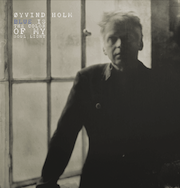
ØYVIND HOLM - BLUE IS THE COLOR OF MY SOUL LIGHT
(LPs from
Crispin Glover Records)
Few could’ve been more pleased than I when the
flag-bearers of country rock from the European
continent (Alt-Europeana, anyone?), Norway’s
Sugarfoot, secured a support tour with Mike Scott’s
Waterboys during the summer of 2025. Their
invariably melodic blend of psych-pop, folk-rock and
far out west(ern) country brings to mind bands like
Cochise in their pomp, and the icing on the cake for
me at least is that their lead vocalist / guitarist
and primary songwriter is none other than Øyvind
Holm, whose career the Terrascope has closely
followed ever since 1997’s first Dipsomaniacs
release blew us away, out through the Deleted
Waveform gatherings era and into his half a dozen
solo releases including, most recently, the superb
‘Blue is the Color of my Soul Light’ (also on
Crispin Glover Records). I tend to think of Holm’s
work as having a similar DNA to Jeff Kelly’s,
wherein the songs are treated as musical canvases on
which he paints his emotions. This album’s a dark
one in some ways, unsurprising perhaps given the
Orwellian reality of the world we live in right now
“where truths are rewritten and history is
distorted”, but there are several glimpses of
lightness and joy too: both the opening and closing
songs of side B are notable in particular, the
bouncy pedal-steel driven ‘Tell Me Babe’ and the
sitar-friendly ‘E-Kit Friend’, respectively, and
another gem is to be found in ‘Random People’s
Cameras’.
But to return to the live Sugarfoot album. Recorded
at the legendary Roundhouse, Chalk Farm, London over
the nights of Saturday May 31st and Sunday June 1st
2025, as with the vast majority of live albums it’s
really one for the fans rather than serving as an
introduction to a band, but it’s beautifully
recorded, and it’s interesting to hear how the band
stretch songs out instrumentally in a live situation
- the closing ‘Waiting for That Mountain to Fall
Apart’ / ‘Tiger Rider’ sequence particularly. Both
originally appeared on 2016’s ‘Different Stars’ (in
the same sequence), one of my favourites of theirs
alongside the LP ‘In the Clearing’ (2019) which is
represented here by the songs ‘Cotton Candy Clouds’
and, the strongest performance on this album
overall, the sublime ‘Changing Times’. ‘Big Sky
Country’ (2014), another personal favourite LP, is
also well represented, with a fine version of ‘How
to Keep Her’. I would’ve liked to have heard a live
take of ‘Dolphins Hotel’ from that same album, as
it’s one of Sugarfoot’s finest recorded moments of
all - there’s always next time though!
A word too, in closing, in praise of the cover,
which is printed on folded card in the style of
letterpress, with faded Grot display type. What’s
not to like?!
(Phil McMullen) |
|
|
Home |
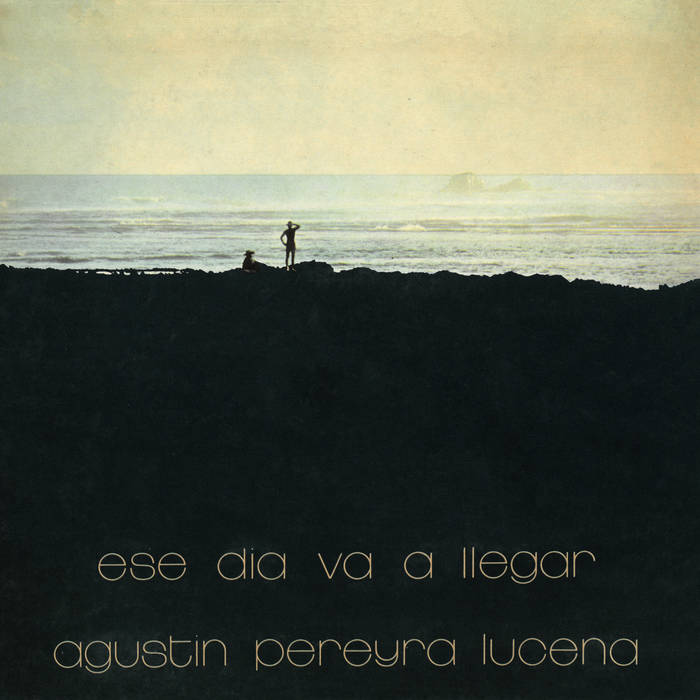
AGUSTIN PEREYRA LUCENA – ESE
DIA VA A LLEGAR
(LP on
Far Out Recordings)
Far Out continues to
re-release the back catalogue of Argentine guitarist
extraordinaire Agustin Pereyra Lucena with tender
loving care. This one, originally released in 1975,
and then in 1976 under the title Brasiliana
in Europe, is considered by some his best-known
work. Lucena always adored the music of his
Brazilian idols like Baden Powell, Vinicius de
Moraes and Toquinho, though he never earned equal
standing to those giants, even if they themselves
had undying respect for him.
"Ese Dia…" finds him firmly established and on
cruise control. His fourth release, it’s full of
breezy bossa nova tunes which can’t help but put you
in a good mood. It represented a turning point for
him, still relying on some covers like Baden
Powell’s 'Maritima,' the chestnut 'The Girl from
Ipanema (Chica De Ipanema)' by Antônio Carlos Jobim,
and João Donato’s 'Amazonas,' while forging ahead
with originals as he was finding his voice.
He was a virtuoso, but on this LP, he seldom flaunts
it, preferring to pursue pure melody, rhythm and
feeling instead of pyrotechnics. Still, examples of
his technical brilliance are on full display on
tracks like 'Viento Que Va' and 'Marítima.' He also
works in vocals on some of the tracks, including his
own confident but understated voice with wonderful
background singing by Laura Hatton, Patricia Scheuer
and Maria Cosenza. 'Amazonas' is a shining example,
with Lucena and Hatton’s bouncy vocals accompanying
the bopping track, which could have been the backing
to myriad romantic movie scenes in the Seventies.
The rhythm section is airtight, featuring long time
collaborators, multi-instrumentalist Guillermo
Reuter and drummer Carlos Carli. Lucena generously
gives up the spotlight for variously, saxophone,
flute and electric piano breaks, all played with
aplomb by seasoned pros. Reuter’s 'Guayabas,' for
instance, is an extended ensemble instrumental tour
de force which sounds like one hell of a fun jam.
The overall result is an upbeat, endorphin-releasing
album. You can’t not like this music. Even the moody
pieces like the way-too-short classical-sounding
palate cleanser 'Ultimo Llamado' with just Lucena on
solo guitar are pleasing and full of warmth. Far Out
Recordings, keep it up, you’re doing something
right!
(Mark Feingold)
|
|
|

Home |
JEREMY
MESSERSMITH -
'Fuck This' (Community Choir Edition)
Bandcamp digital single)
I usually don’t write
reviews of singles, let alone one that’s only a
minute long! But I’d been wondering when the
awakening would occur in the music community and
voices raised against the actions of a regime so
driven by hate, intolerance and violence. Where have
the Pete Seegers, Nina Simones and Billy Braggs
gone? This song is but a tiny morsel, but oh is it
rich.
For those of you who don’t know, Minneapolis has
recently been Ground Zero in the U.S. Immigrations
and Customs Enforcement’s (ICE) repressive campaign
against illegal immigrants and the protesters who
decry their violent methods. After the protester
Renee Nicole Good was killed by ICE, local
Minneapolis musician Jeremy Mesersmith released this
song. Now ICE has killed a second protester, Alex
Pretti, and the song has even more meaning.
With calm, matter-of-fact vocals by Messersmith
while strumming a ukelele, swooping strings by Dan
Lawonn, and a choir featuring local voices like
“Lucy the Anti-Fascist Kitty” and “Teddy Bear and
His Parental Band,” the track sounds like it
could’ve been lifted from a Fred Astaire and Ginger
Rogers musical from the 1930s. The song’s elegantly
affable nature is offset by the biting lyrics, which
perfectly express the outrage of a community and a
nation that’s had enough.
This is a name-your-price track on Bandcamp. All
proceeds are to be distributed to aid organizations.
Have a listen, and chip in a few coins if you
believe.
(Mark Feingold) |
|
|
|
Home |
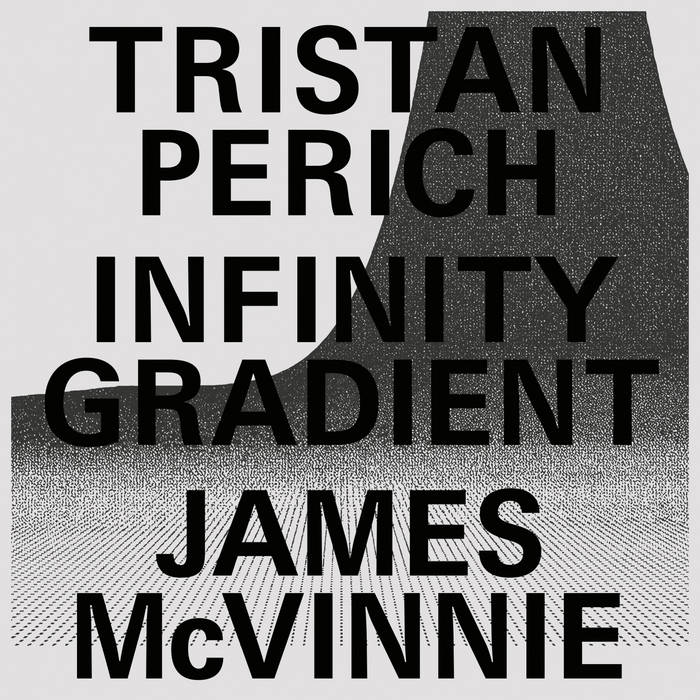
TRISTAN PERICH, JAMES McVINNIE – INFINITY GRADIENT
(LP, Digital on
Erased Tapes Records)
Electronic composer Tristan Perich returns with
another brilliant album marrying one-bit electronics
with classical instrumentation, this time in the
form of the pipe organ, played by James McVinnie.
His one-bit electronics are small devices with
internal circuitry about the size of your hand that
play a single electronic tone. Perich programs
large numbers of them (100 of them on this record)
to bend, weave, converge, diverge, and undulate,
making spectacular sound colors and rhythmic
patterns. In previous records, Perich has combined
them with piano on Surface Image, harpsichord
on Dual Synthesis (2015), a 50-violin string
section on Drift Multiply (2020), and three
vibraphones on Open Symmetry (2024). It
turns out McVinnie’s pipe organ is a perfect
complement to Perich’s mesmerizing electronics.
Recorded in London’s Royal Festival Hall, McVinnie
brings the giant pipe organ alive with the ghosts of
Bach and the Phantom of the Opera, as both
counterpoint and collaborator with Perich’s four
subwoofers, 72 small speakers and 24 medium-sized
speakers.
He
defies categorization, but Perich gets put in the
contemporary classical bin, thanks in no small part
to frequent comparisons with composers like Philip
Glass and Steve Reich. But I felt that his Drift
Multiply was the most psychedelic record I’d
ever heard due to the swirling array of slowly
changing sounds, and still do. This one comes
really close.
I’ve listened to enough Tristan Perich now to have
his pattern down. The tracks often crossfade
together seamlessly, named simply “Infinity
Gradient: Section 1,” “Infinity Gradient: Section
2,” and so forth. You might think you know what
you’re listening to at the beginning of a track,
say, the pipe organ playing in the lower register
while Perich’s electronics are fluttering and
twinkling in a medium pitch, only to find by the end
of the track the organ is playing stabbing high
notes while the electronics are pulsing, agitating
and churning in another part of the scale, and you
have no idea how they got there or where the
transition took place.
The
early movements or “sections” of Perich’s works are
there to establish the sounds of the instruments,
and you can clearly distinguish the pipe organ and
various electronic bits, and the melodic lines are
simple. Somewhere around the middle - on
Infinity Gradient it’s “Section 4,” and on
through the finale of “Section 7” - you’re in the
deep zone, where all the sounds are dizzily
cascading, blinking and frenetically swirling all
around you. “Section 4” in particular is absolutely
mind-blowing. And then there are those subtle,
almost invisible shifts I mentioned above. This
isn’t just cinematic in scope, it’s IMAX-scale.
After an odd slowdown in “Section 5,” the work
segues imperceptibly and picks up again with
“Section 6.” It’s an ethereal arpeggiating burst of
saturated technicolour sound. Eventually McVinnie
applies a rumbling low frequency organ swimming
upstream against the cascading electronic melody.
The highlight is then an ultra-slow building, rising
glissando on the electronics, which took months for
Perich to program. This then blends naturally into
some higher, quiet notes on the organ as weird,
creepy descending electronics eventually herald the
end of the movement and another seamless segue into
the finale, “Section 7,” which is an industrial
assault on the senses.
Infinity Gradient is
another work of genius by Tristan Perich, ably
abetted by James McVinnie. The work has been
performed live, and I’d give anything to see it. To
have a gargantuan pipe organ and those 100 speakers
surrounding you must be quite a spectacle. It’s a
trippy composition that overtakes you and sets your
mind ablaze with imaginative images.
(Mark Feingold) |
|
|
|
|

Home |
ELKEYES - ELKEYES
(Digital on
Bearsuit)
For nearly 25 years and 70 releases the
Edinburgh-based Bearsuit lable has given us
ample reason to cry, cheer, run screaming from the
room in terror, and scratch our heads in glassy-eyed
wonder (occasionally all at once). Elkeyes is their
latest experiment in terror, tiptoeing through
gothic, hauntology, ambient, and soundtracks that De
Wolfe would only be caught dead in releasing.
'Trial' may be the perfect prescription of the avant
skronk atonal jazz meanderings that greet you upon
entering. I heard hints of the metallic edge of
krautrockers like Faust and Einstürzende Neubauten
knocking at the door. 'Yamanote Line' might wake the
walking dead with its ear-piercing shrieks and
creepy-crawly electronics that the hairs on the back
of your neck may stand up and salute. As horror
soundtracks go, this would work perfectly behind a
remake of the classic Outer Limits episode
"The Zanti Misfits." And as the Alien tagline
reminded us, "In space, no one can hear you scream."
I had to look up
'Thalassophobia' after I finished shitting myself -
let's just say my Summer's ruined and I won't be
going near the ocean any time soon. There're live
things in there! The stalking, syncopated
electronics create a tension and creeping terror
that rivals John Williams' Jaws soundtrack.
It all gives new meaning to "waiting for the other
shoe to drop!"
More soundtrack fun
awaits in 'The Dark Forest' which amped up my heart
rate and had me looking over my shoulder for the
bogeyman in hot pursuit. Somewhat reminiscent of
John Carpenter's Halloween score, although
its repetitive riff adds an hallucinatory effect
that's hard to shake. 'Ephemeral' is a seven-minute
tone poem akin to Eno experimenting with a new
electronic toy. Not exactly 'Music To Fall Asleep
To,' but I guarantee it will remain in your head
long after it ends. I think they give hearing tests
that approach these frequencies, so you might want
to send the dogs into another room.
'Evensong' is more
relaxing as its title implies, but we're
shredding
traditional boundaries here, so there is another
horror-film soundtrack in the offing (think
Rosemary's Baby, Eraserhead, and their
ilk). Closer 'Fallen' resurrects the stark musical
landscapes of Bowie's Low and György Ligeti's
'Atmospheres' to chilling effect.
If you've worn out
your OHM: Early Gurus of Electronic Music box
set, this is a welcome addition to
your music library. Fans of artists exploring the outer edges of
experimental electronic music from Eno and White
Noise to 50 Foot Hose, Kemialliset
Ystävät, and the Magic Carpathians Project will also
be right at home with Elkeyes.
(Jeff Penczak) |
|
|
|
| |
|
| |
|
| |
|
|
|
|
| |
|
| |
|
|
 |
|